Home › Concrete Retaining Walls
Control slopes and add structure to your yard with concrete retaining walls in Chesapeake, VA. We build structural and decorative retaining walls to manage erosion and create level spaces. Our team installs reinforced concrete and block walls with proper drainage and footings. Request a free design consultation for your retaining wall project today.
Superior Concrete Chesapeake provides professional concrete retaining wall throughout Chesapeake, VA, Virginia and the surrounding area. Our licensed, insured crew delivers safe, clean, on-time work with a free estimate before anything begins. Call (757) 780-5778 or request your free quote.
Practical Concrete Retaining Wall Solutions for Chesapeake Yards
If your yard slopes, holds water, or is slowly pushing soil toward your house, a concrete retaining wall can solve several problems at once. At Superior Concrete Chesapeake, we build concrete retaining walls that are meant for our local soils, tides, and weather, not just a picture in a catalog.
In Chesapeake, we see a lot of heavy clay and fill dirt that hold water after storms. That extra moisture can put real pressure on a wall, especially along ditches, around walkout basements, and behind driveways. When we look at your property, we do not only ask where you want the wall. We check how the ground drains, how close utilities and property lines are, and whether the wall might affect a neighbor or a shared drainage easement.
Concrete retaining walls are ideal when you need strength and long-term stability. They are great for holding back higher slopes, creating level areas for patios or play spaces, protecting driveway edges from washouts, and giving structure to low spots that stay soggy. On many Chesapeake lots, a properly built wall can turn an unusable side yard into flat space for parking a boat or trailer.
Our goal is to build something that works first, and looks good second, without you paying for more structure than you need. We walk you through what type of concrete retaining wall makes sense for your yard, how it will be built, and what it will cost before we ever start digging.
Types of Concrete Retaining Walls We Build (And When They Make Sense)
Concrete retaining walls are not one-size-fits-all. Superior Concrete Chesapeake offers several construction methods, and we match each style to your yard conditions and budget.
Cast-in-place concrete walls: These are formed and poured on site using rebar for strength. They are the best choice for taller walls, tight spaces, curves, or when you want a smooth or decorative finish. Cast-in-place walls are common along driveways, walkout basements, or where the city ditch is close to your property line and we need a slimmer profile.
Concrete block (CMU) walls: These use stacked concrete masonry units, reinforced with rebar and filled with concrete. They are strong, more flexible in design than a simple poured wall, and a good option when we need a structural wall that can also be finished with stone or stucco. We often use CMU for terraced garden walls and for areas where we might step a wall up or down with the slope.
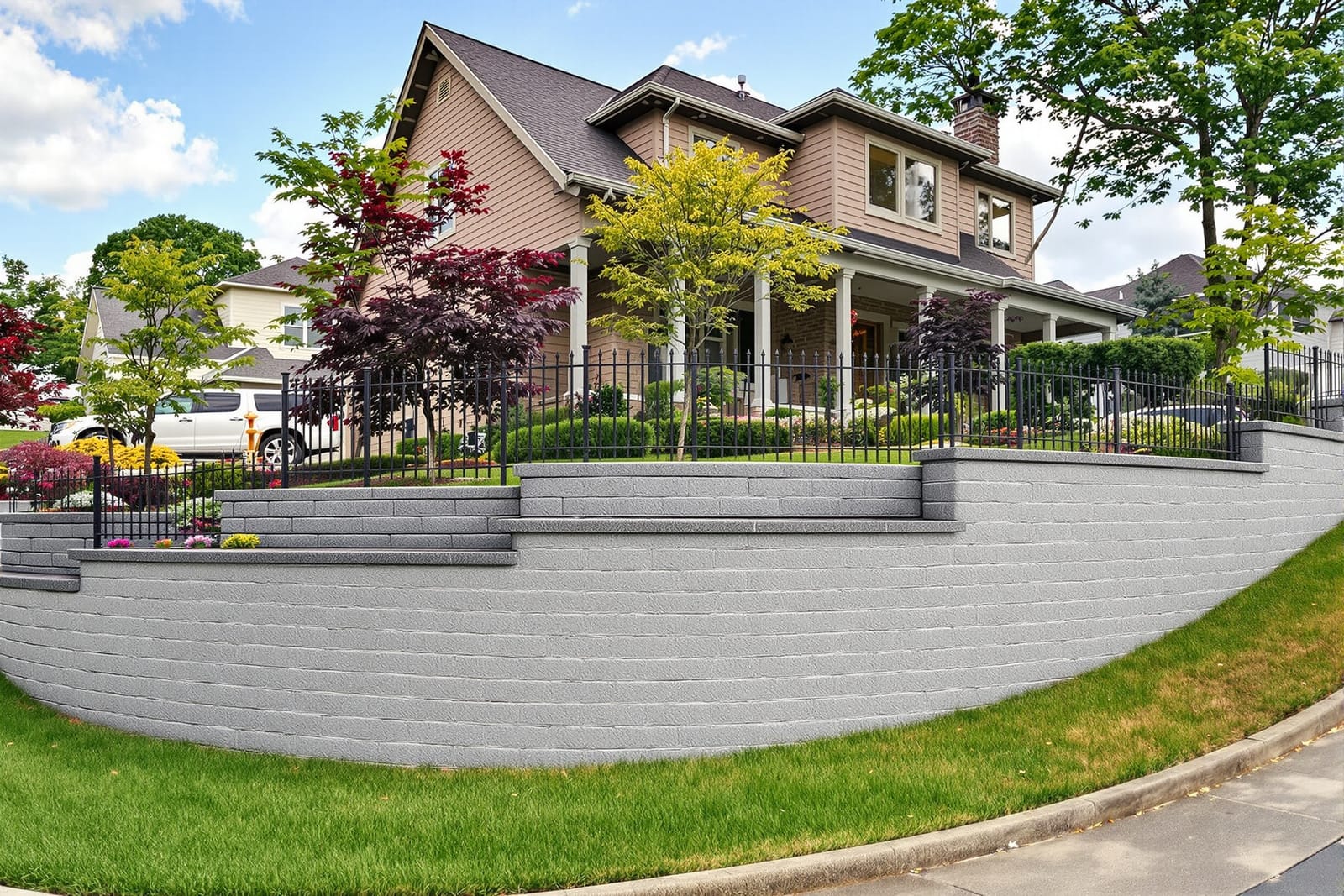
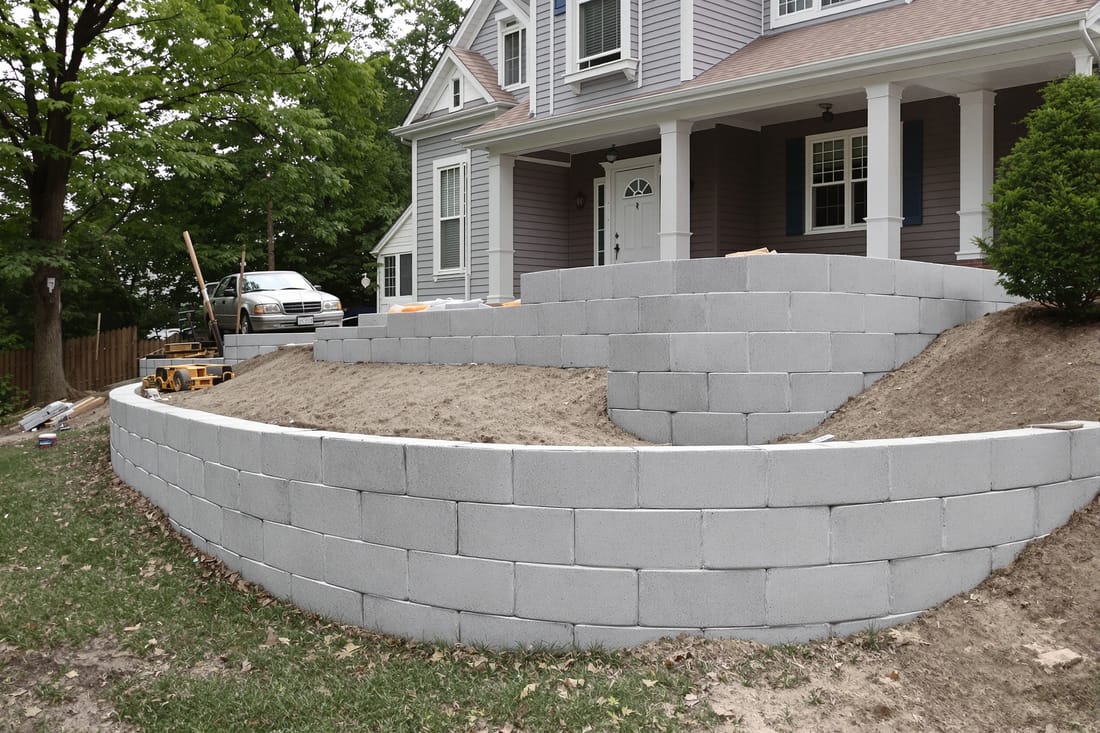
Segmental concrete retaining walls: These use interlocking concrete blocks that are designed to lean slightly back into the soil. Some versions are gravity walls (heavy units stacked without rebar), and for higher walls we add geogrid into the soil behind the wall to tie everything together. These are common along backyard slopes, around patios, and beside driveways where homeowners want a textured block look instead of a plain concrete face.
Decorative concrete finishes: For cast-in-place and CMU walls, we can add color, a stamped pattern, or a stucco or stone veneer to match your home. We are honest about what is decorative and what is structural so you understand where your money is going. Many Chesapeake homeowners choose a simple broom finish on the back yard side and reserve decorative treatments for the more visible front yard sections.
How We Design and Build a Strong Concrete Retaining Wall
A retaining wall is a small engineering project, not just a line of concrete. Here is how Superior Concrete Chesapeake typically handles the work so your wall stays put for the long term.
Site visit and planning: We start with measurements, photos, and elevations if needed. We note any utilities, easements, fences, and trees that might affect the layout. For walls above typical height limits or in sensitive areas, we may recommend a local engineer to provide stamped drawings, especially when the city or your HOA requires it.
Layout and excavation: Once we set the wall line, we excavate for the footing or base. For poured and CMU walls, that means a trench deep enough for a reinforced concrete footing below the frost line and down to firm soil. For segmental walls, we remove enough soil to place and compact a thick, level base of crushed stone so the first course is perfectly supported.
Drainage and backfill prep: Hydrostatic pressure destroys more retaining walls than anything else. We install perforated drain pipe behind the wall at the base, wrap it in fabric where needed, and run it to daylight or a drain outlet. Behind the wall we use clean gravel or a graded aggregate zone to allow water to move freely. Then we transition to compacted soil further back. All backfill is placed in layers and compacted so the wall is not slowly pushed over by settling soil.
Reinforcement and concrete work: For cast-in-place and CMU walls, we install vertical and horizontal rebar according to design. We tie the wall into the footing and sometimes into adjacent structures, like a set of stairs or a concrete driveway. Concrete is placed with enough slump to consolidate well without washing out fine details, then we vibrate or rod it to remove air pockets. Forms stay in place until the concrete has gained enough strength to stand on its own.
Finishing, cleanup, and inspection: Once the wall is set, we add any surface finishes, weep holes, caps, and transitions to existing grades or hardscapes. We clean the site and make sure any disturbed lawn areas are raked smooth. If the city or an engineer requires an inspection, we schedule it and make sure your project passes before we call it complete.
Permits, HOAs, and Local Rules for Retaining Walls in Chesapeake
In Chesapeake, the rules for a concrete retaining wall depend on the wall height, location, and what it is supporting. It is important to know these details before you start building or you can be forced to modify or remove a wall later.
Permits and engineering: As a general guideline, shorter walls may not need a building permit, while taller walls or walls that support driveways, parking areas, or structures often do. Walls above certain heights usually must be designed by a licensed engineer. Superior Concrete Chesapeake can help you figure out which category your wall falls into and coordinate with a local engineer when the city requires stamped plans.
Setbacks and easements: Many Chesapeake neighborhoods have drainage easements along the back or sides of lots, especially near ditches and low areas. Building a concrete retaining wall inside that easement can cause issues with the city or with neighbors if water has nowhere to go. We review your survey or plat with you, mark out known easements, and design the wall to stay clear of those zones or provide proper drainage through or around the wall.
HOA requirements: Several Chesapeake communities in areas like Great Bridge, Greenbrier, and Hickory have HOA guidelines about wall height, materials, and appearance visible from the street. We can provide sketches, product information, and color samples for your HOA submission and can adjust the design if they require a specific look, such as a stone-textured block or neutral color palette.
Drainage and neighbor impacts: Local stormwater rules focus on keeping runoff from being pushed onto neighboring lots or into the street. When we plan a retaining wall, we look at where water will end up once your yard is regraded. We often integrate surface drains or swales along with the wall so you do not fix one problem and create another for the property next door.
Costs, Common Problems, and How to Choose the Right Contractor
Concrete retaining wall pricing in Chesapeake depends on real conditions in your yard, not just wall length. Some of the main cost drivers are wall height and length, type of wall system, soil conditions, access for equipment, and any required engineering, permits, or decorative finishes.
Wall height and length: Taller walls require thicker concrete, more rebar, larger bases, and often engineering. Two shorter terraced walls can sometimes be more cost effective than one very tall wall and can also be easier to permit. Length affects labor and material, but usually more gradually than height.
Soils, access, and drainage work: Soft or wet soils, buried debris, or tree roots increase excavation time and may require a wider base or soil replacement. Tight access that will not allow machinery can increase labor because more has to be dug or moved by hand. Walls that solve real drainage problems usually need more gravel, drain pipe, and careful grading, all of which affect price but are worth it to avoid future movement or cracking.
Common retaining wall problems we see in Chesapeake include bulging or leaning walls from poor drainage, cracked or heaving walls from shallow footings, and block walls without geogrid that are simply overloaded. When replacing a failed wall, we pay special attention to why it failed, then redesign the new concrete retaining wall with proper base, drainage, and reinforcement so the problem does not return.
When you choose a contractor, ask how they handle drainage, what base materials they use, how they compact backfill, and whether they are familiar with local permitting and HOA expectations. Superior Concrete Chesapeake is happy to walk you through past Chesapeake projects, explain our construction details in plain language, and provide a written scope so you know exactly what your new concrete retaining wall includes before you say yes.